Mevlevi Sema Ceremony: Meaning, Costumes, and Ritual
The pine floorboards of the Galata Mevlevihanesi had grooves worn straight through the grain, cut deep by centuries of bare, calloused feet. When you sit on a floor cushion on a chilly Istanbul evening, smelling beeswax and damp limestone, you realize quickly that you are not at a folklore show. The lights drop. A singer in the wooden gallery above chants a slow prayer, his voice breaking slightly on the higher registers. Then comes the reed flute, carrying a low sound that seems to vibrate inside your ribcage. This ancient prayer ritual, known formally as the sema ceremony, is a physical meditation that has survived political bans, social upheaval, and the crush of mass tourism.
Most travelers stumble across the ritual while planning a trip to Turkey, mistaking it for a dinner show or an acrobatic feat. It looks mesmerizing on video, but being in the room is different. The air cools down as the heavy wool skirts start spinning, pushing small gusts of breeze against the front row of spectators. To make sense of what is happening on that circular floor, you have to look past the graceful optics and unpack the centuries of mysticism, precise dress codes, and philosophical stages baked into every movement.
Book your whirling dervish istanbul experience:
Origins and Spiritual Meaning of the Sema Ceremony
The practice began with Jalal al-Din Muhammad Rumi, the 13th-century Persian poet and theologian who lived and taught in Konya. Legend says Rumi was walking through the city's goldsmith market when the rhythmic hammering of apprentice craftsmen struck him with pure ecstasy. He began turning in circles on the dusty street right there, lost in devotion. His followers organized those spontaneous turns into a structured liturgy after his death in 1273. It was codified by his son, Sultan Walad, turning a personal burst of emotion into an enduring path of spiritual surrender.
This is not a folk performance. In Sufism, the ritual represents man's ascent through mind and love toward perfection, shedding the ego along the way before returning to earth to serve others. Because of its deep cultural footprint, the unesco mevlevi sema ceremony whirling dervishes heritage recognition was granted back in 2005. That listing helped rescue the tradition from becoming nothing more than a cheap restaurant gimmick, preserving the strict spiritual codes of Mevlevi whirling as living worship.
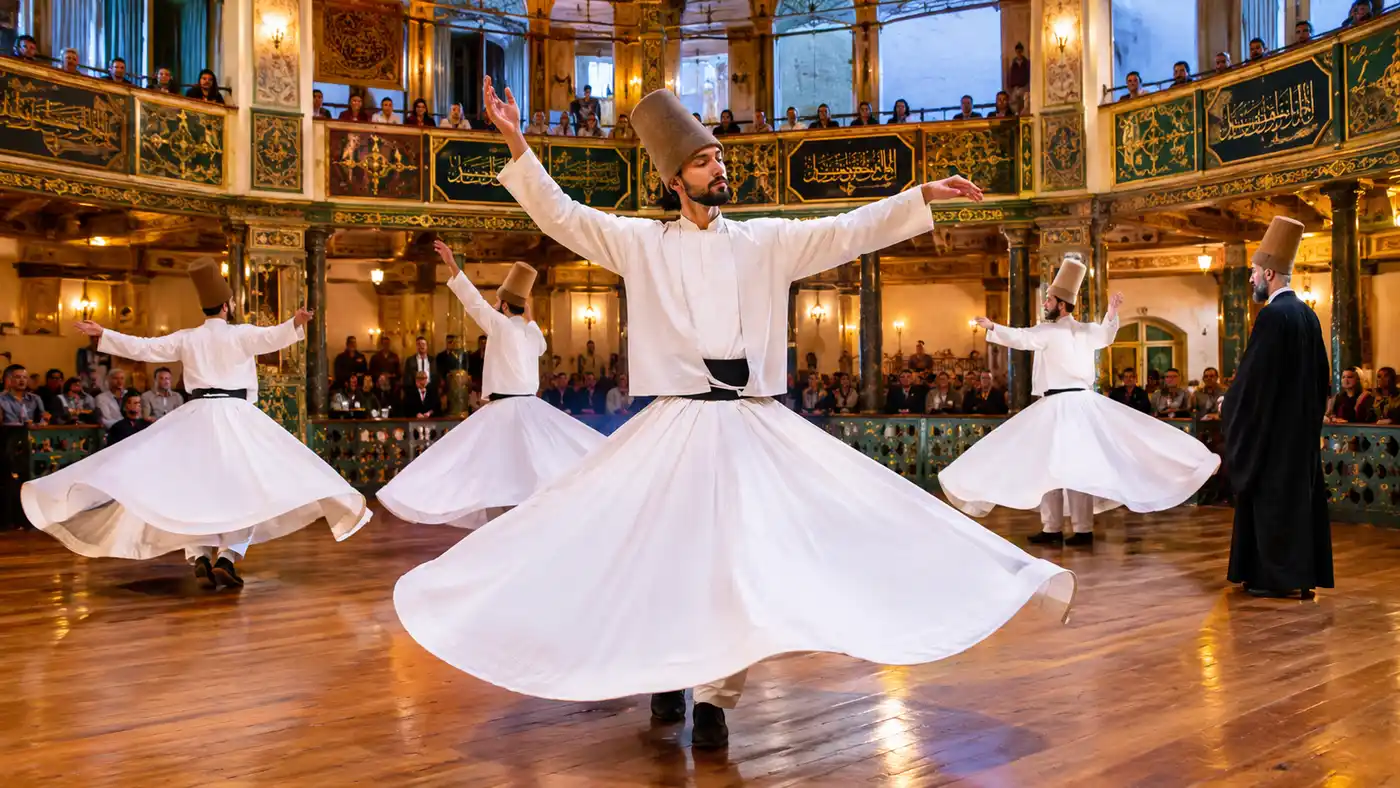
The geometry of the hall matters immensely. The circular floor represents the cosmos, with the leader, or Postneshin, standing on a red sheepskin at the far side. Red is the color of the setting sun, recalling the day Rumi passed away and met his divine creator. When the semazen, the practitioners of Sufi whirling, step into this ring, they enter an orbit around a sun. Nobody crosses the invisible axis between the red pelt and the doorway. It is considered sacred ground, representing the shortest path to union with God.
The Meaning of Makeup and Costume of Whirling Dervish Tradition
People often ask about the meaning of makeup and costume of whirling dervish performers, usually assuming there is theatrical paint involved like in classical theater or circus acts. There is zero makeup. Real dervishes scrub their faces clean before stepping out onto the floor. Any cosmetic enhancement would contradict the point of the ritual, which is the total dissolution of personal vanity. What you see on their faces is just pale concentration, sweat, and occasionally a closed-eyed trance as they complete their revolutions.
The garments, though, tell a solemn story. Every single item of the costume represents an element of death and the grave, worn openly as an embrace of mortality. Before a dervish begins spinning, he is dressed for his own funeral.
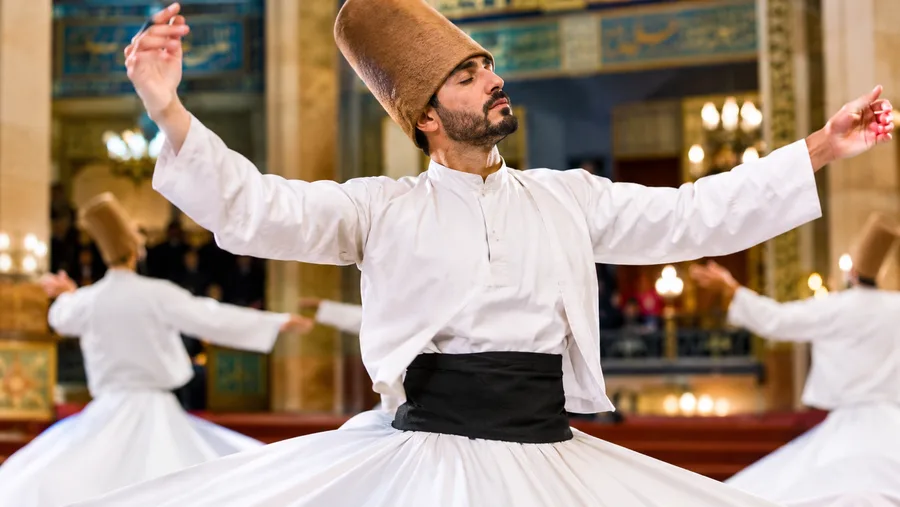
The hat, called a sikke, is made of stiff camel hair felt. It stands tall and conical, colored a dusty honey brown, representing the tombstone of the ego. Over their shoulders, they drape a heavy black cloak known as the hırka. This cloak represents the cold dirt of the grave. Beneath the cloak lies the tennure, a sleeveless white vest and a voluminous, flared skirt sewn from thick wool or heavy cotton that symbolizes the burial shroud. Tying it all together is the elifi nemed, a sash bound tightly around the waist that reminds the seeker to stay centered.
Note: Some commercial venues put dervishes under gaudy ultraviolet lighting or use silky polyester skirts that float erratically. Authentic ceremonies always feature heavy, off-white wool garments that fall with deliberate weight and drape.
When the semazen enters the floor, he remains enveloped in black. Only when the permission to whirl is granted does he cast off the black cloak, dropping it to the floor. This single movement signifies casting off worldly attachments and rising from the tomb into spiritual rebirth. The white skirt then bells out under centrifugal force, creating a wide disk of pure cloth that hums softly against the air.
The Ritual Unfolded: Stages of the Turkish Dervish Dance
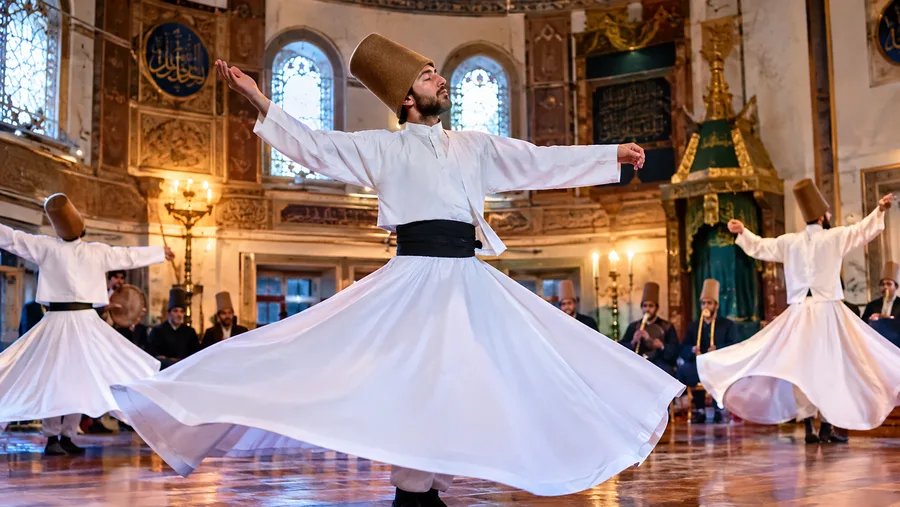
The ceremony follows a rigid, seven-part liturgy that usually takes about 45 to 60 minutes from start to finish. It begins with the Naat-i Sharif, a solo praise hymn dedicated to the Prophet Muhammad. Then the kudüm, a pair of small kettledrums, beats out a steady rhythm representing the initial divine command that sparked creation. A reed flute, the ney, follows with an improvised solo. In Sufi poetry, the hollow reed flute represents humanity, cut from its native reed bed, pierced with holes, and weeping to be reunited with its source.
Next comes the Devr-i Veled, or the Sultan Walad circle. The dervishes slowly walk around the perimeter of the hall three times, led by the master. As each man reaches the red sheepskin, he turns, bows deeply to the man behind him, and steps forward. They are greeting the divine spark within one another. Only after this third circle does the real physical motion of the turkish dervish dance begin.
The whirling itself is divided into four distinct musical movements, known as the Selams. Each has its own rhythm, tempo, and theological purpose:
| Stage | Musical Tempo | Spiritual Meaning | Dervish Movement |
|---|---|---|---|
| First Selam | Slow, dignified | Awakening to divine existence | Tentative turns, arms slowly unfolding from chest |
| Second Selam | Gathering pace | Admiration of God's creation | Right palm turned upward, left palm pointing down |
| Third Selam | Fast, intense | Surrender of reason to divine love | Full spinning speed, skirts fully flared, heads tilted |
| Fourth Selam | Calm, measured | Return to earthly duty as servant | Slower spinning, arms gradually returning to cross chest |
Watch their hands closely during the third movement. The right arm reaches upward toward the ceiling, open palm facing the sky like an empty bowl ready to receive blessings. The left arm hangs lower, palm facing the floorboards. The dervish acts as an electrical conduit. He receives divine love from the sky and passes it directly to the earth without holding anything back for his personal ego. He turns continually from right to left, anchored on his left foot while his right foot pushes him around, revolving counter-clockwise like the planets around the sun.
The room fills with a rhythmic whoosh. You can hear the heavy slap of bare soles or soft leather slippers pivoting against timber, 30 or 40 times a minute. It looks exhausting, but the dervishes train for months by practicing around a wooden peg held between their toes to keep balance. They tilt their heads slightly to the right, resting the ear against the collarbone. This posture pinches the inner ear canal, preventing the dizziness that would otherwise make a normal person vomit within ninety seconds.
Book your whirling dervish istanbul experience:
What to Expect When Watching Sufi Whirling in Person
Sitting in the audience is a practice in discipline. Western tourists often expect a theater performance, with applause between movements, photo opportunities, and theatrical lighting. You get none of that at a genuine tekke. The atmosphere is quiet, dense, and contemplative. The musicians sit quietly in their balcony, plucking stringed instruments like the tanbur and beating soft strokes on the drum skins.
Pro tip: Arrive roughly 35 minutes early to secure a seat along the floor railing rather than in the back rows. Being close lets you hear the heavy breathing of the dervishes and feel the breeze of the skirts as they spin past.
To avoid disrupting the room, keep these behavioral rules in mind:
- Do not clap: Applauding a dervishes dance is considered rude because you are interrupting a prayer session, not rewarding performers.
- Keep your camera quiet: Turn off all shutter sounds and do not use a flash, which can disorient a spinning dervish and cause a collision.
- Cover your legs and shoulders: Even at venues run for the public, these halls are consecrated spaces where conservative attire shows basic respect.
- Stay seated until the final exit: Getting up mid-ceremony to slip out early creates distracting shadows and floorboard squeaks that break the room's focus.
Sometimes you see small children brought along by local families. They sit wide-eyed on the carpets, watching the skirts flare outward like spinning lampshades. It is common for older locals to close their eyes and quietly finger their prayer beads in rhythm with the drum. If you want to experience this without tourist buses idling outside, check our suggestions for finding an authentic venue in Istanbul before booking tickets through third-party hotel desks.
Where Ritual Meets Modern Performance
Honesty requires admitting that the modern reality of the whirling dance is complicated. In 1925, Mustafa Kemal Atatürk, the founder of modern Turkey, outlawed all Sufi lodges as part of his aggressive secularization reforms. The historic lodges were boarded up, converted into state museums, or left to gather dust. For decades, the Mevlevi tradition went underground, practiced behind closed doors in private family living rooms with blankets hung over windows to muffle the sound of the reed flute.
In the 1950s, the Turkish government realized that international interest in Rumi was huge. They allowed public demonstrations to resume, but strictly under the label of "cultural presentation" rather than religious worship. This legal distinction created an odd gray area that persists today. Some ceremonies are devout spiritual gatherings held by genuine practitioners, while others are quick commercial shows staged in hotel basements or between belly-dancing acts on Bosphorus cruise boats.
I find the cruise ship versions depressing. Seeing two tired men in polyester skirts spinning while people eat cold chicken and sip raki feels like a hollow caricature. If you want to witness real mevlevi whirling, you need to know how to sift the genuine from the commercial:
- Location context: Authentic ceremonies happen inside historical Mevlevihane (cultural centers) or cultural foundations, never in restaurants or dinner theaters.
- Musical presence: Genuine ceremonies feature a full, live acoustic ensemble seated above or beside the floor, never a pre-recorded audio track played through speakers.
- Participant age: Staged shows typically employ young dancers doing acrobatic tricks; authentic rituals involve men of varying ages, from teenagers to men in their seventies.
- Ticket prices: Genuine cultural societies usually ask modest entry donations around 400 to 600 Turkish lira, unlike glitzy hotel ticket desks that charge 60 euros.
When you watch real turkish dancers spinning with purpose, the energy in the room shifts. The repetitive counter-clockwise turning produces a subtle hypnotic pull. You find your own breathing slowing down to match the drone of the ney. It is easy to see how people with no interest in medieval theology walk out of the hall feeling strangely calmed, as if the dust of modern city traffic had been swept away by the hem of a wool skirt.
Frequently Asked Questions about sema ceremony
Why do the dervishes spin in circles?
They spin to mirror the movement of everything in the universe, from atoms to planetary orbits. By turning counter-clockwise while keeping the heart anchored, the dervish seeks to strip away his physical ego and experience harmony with divine will.
Can women participate in the whirling ceremony?
Historically, women practiced the ritual within private female quarters of the lodge. In modern times, several contemporary Sufi orders, particularly outside of strict orthodox circles, hold mixed ceremonies where women spin alongside men in identical ceremonial dress.
How long does a typical dervish ceremony last?
The full ritual usually runs between 45 and 70 minutes. The actual physical turning happens in four separate segments lasting about 8 to 12 minutes each, separated by brief musical interludes and prayer salutations.
Quick Reference
- Founded in Konya, Turkey after Rumi's death in 1273.
- Costumes represent death: tall hat is the tombstone, white skirt is the shroud.
- Strictly no applause or camera flashes during the 45-minute liturgy.
- Turns counter-clockwise with right hand up to heaven, left hand down to earth.
Book your whirling dervish istanbul experience:
Before You Go
Do not go to a tekke looking for entertainment. If you want high drama, backflips, and cheerful folk music, head to a Turkish night show in Cappadocia instead. But if you have an hour to spare on a slow evening, find a wooden lodge, leave your shoes on the rack at the entrance, and sit down quietly on the rugs. Watch the tall felt hats tilt back. Listen to the steady rustle of linen beating against the quiet air. In a world moving at manic speed, watching someone spend forty minutes turning slowly in place, content with nothing but a drumbeat and a breath, feels like the rarest thing on earth.
Read more about whirling dervish istanbul.